- 300+organisations in our database
- 46,000+possible partner pairings
- 6factors screen every pairing
- 2sides agree before every introduction
The European Commission describes an industrial ecosystem as every player in a value chain: from the smallest start-ups to the largest companies, from academia and research to service providers and suppliers.
Paraphrased from the European Commission, EU industrial strategy (2020, updated 2021)
From closed, to open, to global ecosystems
- PastClosed innovationIdeas stay inside one company
- PresentOpen innovationIdeas and technology cross the boundary
- NextGlobal ecosystemsOrganisations across markets combine capabilities
- Company boundary
- Open boundary: ideas flow in and out
- Organisations across markets
- Partnership, agreed by both sides
Closed innovation
Centralised, inward-looking innovation: research, development and sales inside one company.
Open innovation
Externally focused, collaborative innovation: ideas and technology cross the company boundary in both directions.
- Company
- Start-up
- Institution
- Capabilities combined
Global ecosystems
Ecosystems that connect companies, start-ups and institutions across markets, so that capabilities combine wherever they are.
From facilities to business support
Open innovation depends on two kinds of ties: within an ecosystem and between ecosystems. JHC connects partners across the levels in Japan and links Japan with your home ecosystem.
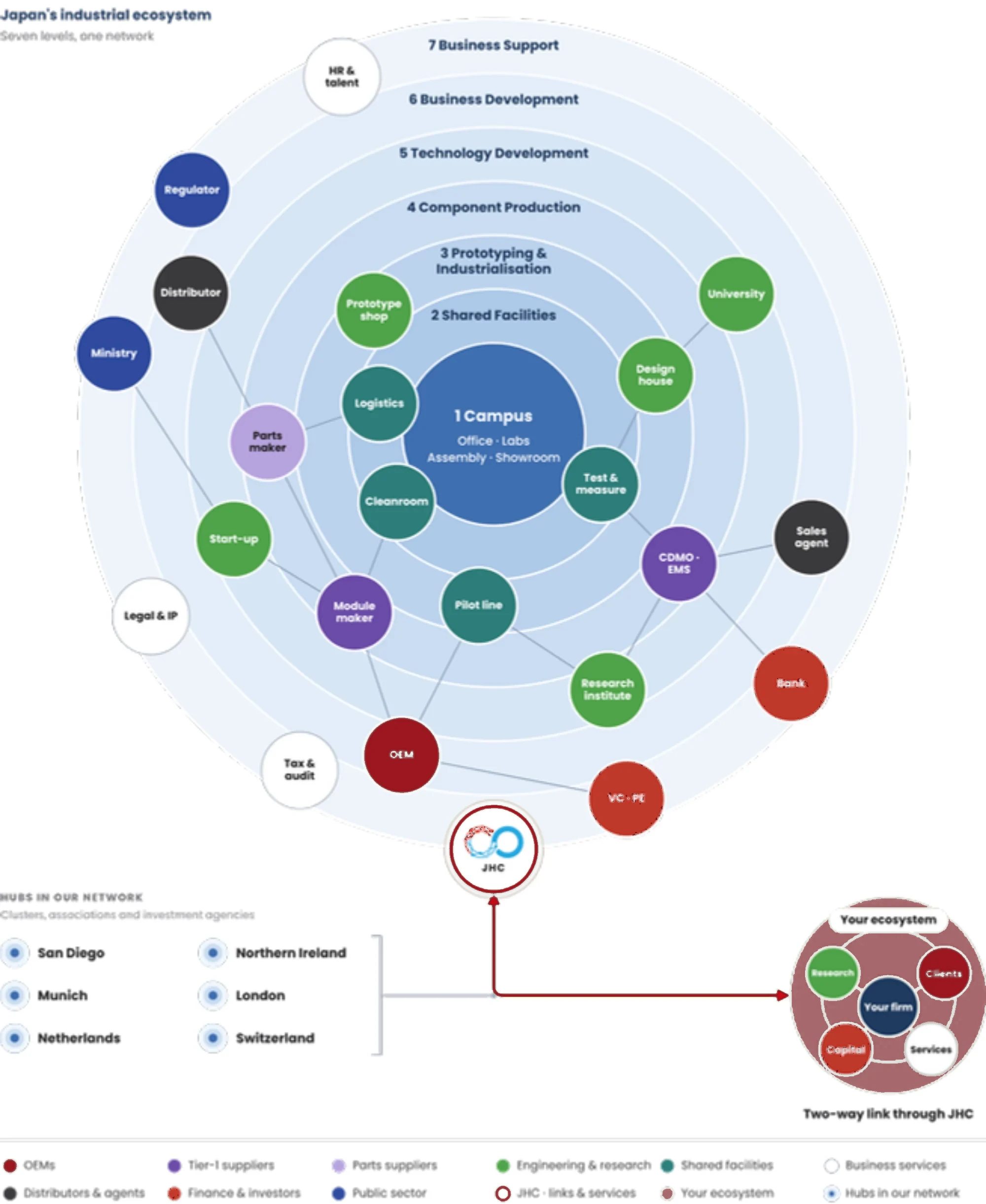
- 01
Campus
Office, labs, assembly and showroom
- 02
Shared facilities
- 03
Prototyping and industrialisation
- 04
Component production
- 05
Technology development
- 06
Business development
- 07
Business support
Within an ecosystem
Companies, research, government, and finance and services, working together in one place.
Between ecosystems
Markets connected through partners who know each other, so that know-how and products can travel.
Four stages that reinforce each other
Open resources draw more members. More members make a denser, more trusted network. A denser network makes better matches, and what we learn returns as open resources.
Open resources
The GIEI index, ECOSYSTEM Monthly and the Partnering Board, open to every participant.
More members
More companies join and share what they need and what they offer.
A denser, trusted network
More ties on record, and introductions made only with consent.
Better matches
Every match teaches us something, and what we learn returns as open resources.
Ten times the members, 110 times the partner options
Every new member is a possible partner for every member already in.
Possible partnerships between n members: n times n minus 1, divided by two. Matching narrows them to the ones worth an introduction.
Seven principles that decide how we work
They apply to every service, every tool and every introduction.
Fair and objective
Our own presence in a market never changes a score, a ranking or a recommendation.
Only the two companies count
A partnership is judged on the two companies alone: needs, capabilities, sectors, markets and stage. Not on our fees, and not on our relationships.
Market data first, then regulatory review
The index shortlists locations. The regulations that apply are then checked route by route.
Probabilities, not promises
Our tools give ranges and probabilities, and show the assumptions behind them.
Human review
AI output is a draft. A person checks it before it reaches you.
Consent first
Introductions only when both sides agree, and no one needs a reason to decline.
The right professional for regulated work
Legal, tax and filing work is done by licensed professionals, in their own name.
Six UN goals guide our work

JHC supports the Sustainable Development Goals.
Cross-border cooperation in life sciences and healthcare
Clean energy for AI compute and green data centres
Local jobs and investment through cross-border industrial projects
Advanced manufacturing, technology licensing and co-development
Compliance and quality management for consumer products
Connecting companies, institutions and markets via the partner network
The SDG logo and icons are used for information only, following the United Nations guidelines. Their use does not imply endorsement by the United Nations of JHC, its services or its activities.
Join the global industrial ecosystem

Request a consultation
For companies entering Japan or expanding abroad from Japan: a complimentary 30-minute call with our Tokyo team to discuss your plans.
Request a consultation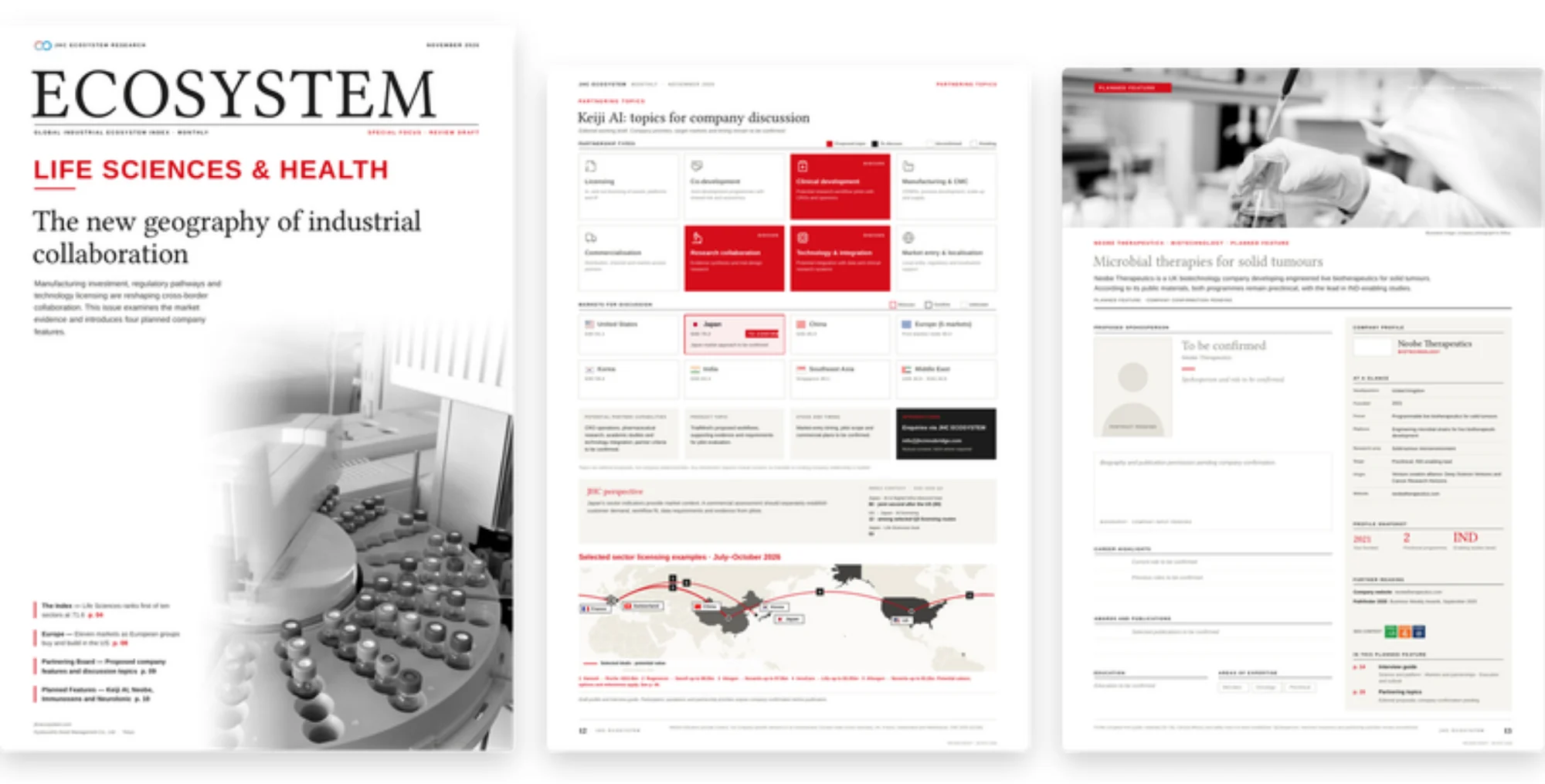
Subscribe to our publications
For executives following cross-border industry: index readings, cross-border cases and partnering needs, delivered by email.
Subscribe